Quick Summary:
Cold leads convert when you qualify them properly, personalize your first message, and follow up on a consistent schedule instead of a single cold email. This blog walks through a six-step lead conversion framework, the most common mistakes that keep prospects stuck, and how AI lead-scoring tools help agencies prioritize the contacts most likely to buy. By the end, you’ll have a repeatable process for turning unengaged contacts into paying customers, not just more names on a list.
For agencies and freelancers managing multiple client accounts, this kind of lead conversion is rarely about volume. It’s about timing, relevance, and knowing which contact to reach out to first. The framework below covers qualification criteria, outreach sequencing, and the metrics worth tracking, along with a real example of how this plays out for a local service business.
What Stops Cold Leads From Converting
If you’ve ever stared at a spreadsheet full of cold leads wondering why none of them are replying, you’re not doing anything wrong; you’re just missing a system. Most businesses treat these contacts like a numbers game: send enough emails, make enough calls, and eventually someone bites. That approach burns time and goodwill fast.
Turning cold leads into customers actually comes down to a handful of repeatable steps: qualifying the right contacts, personalizing your outreach, choosing the right channel, and following up with value instead of pressure. This guide breaks down exactly how to do that, with a framework you can apply whether you’re running outreach for your own business or managing lead conversion for multiple clients.
For agencies looking to make this process more consistent, LeadsGorilla provides tools that help identify qualified prospects, uncover business opportunities, and support more targeted outreach. That makes it easier to move from simply having a list of cold leads to knowing which prospects deserve attention first.
What Are Cold Leads (and Why Do They Feel So Hard to Convert)?
A cold lead is someone who fits your ideal customer profile but hasn’t interacted with your brand yet. They haven’t opened an email, visited your site, or shown any sign they know you exist. That’s different from a warm lead, who has already engaged in some way, and a hot lead, who is actively comparing options and close to buying.
These contacts feel harder to convert because there’s no existing trust to build on. You’re starting the relationship from zero, which means your first message has to do more work than a simple “just checking in.”
Cold Leads vs. Warm Leads vs. Hot Leads
- Cold leads: No prior interaction, may not know your brand exists yet.
- Warm leads: Have engaged once or twice, downloaded something, or been referred.
- Hot leads: Actively evaluating, asking about pricing, or requesting a demo.
Understanding where a lead sits matters because a cold lead who gets a hard sales pitch on day one usually goes colder, not warmer.
Why Most Cold Leads Never Convert
The biggest reason these leads stall out isn’t a bad list; it’s a generic approach. Sending the same message to every contact, following up once and giving up, or reaching out with no context about the prospect’s actual problem are the fastest ways to lose a lead for good.
The Real Cost of Ignoring Cold Leads
Every unconverted cold lead represents money already spent to acquire it, whether through ads, scraping tools, or manual research. Letting leads sit untouched in a spreadsheet doesn’t just waste that initial investment; it hands the opportunity to a competitor who follows up first.
For agencies managing lead conversion on behalf of clients, this cost compounds. A prospect list that goes stale after 30 days is far less valuable than one worked consistently from day one, which is part of why timing matters as much as messaging.
The Step-by-Step Lead Conversion Framework
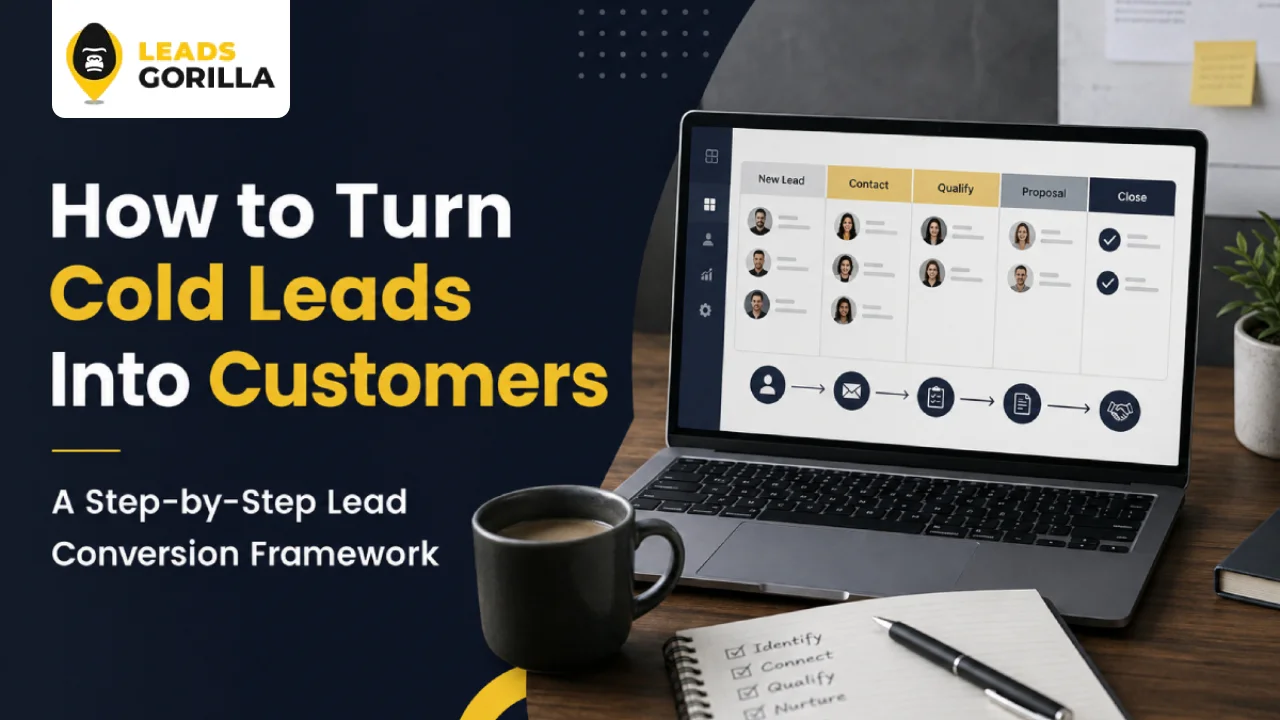
This framework gives agencies and businesses a repeatable process for moving unengaged contacts toward a sales conversation and, ultimately, a purchase.
Step 1: Qualify Before You Reach Out
Not every cold lead deserves the same amount of effort. Before sending a single message, check whether the contact matches your ideal customer profile: right industry, right business size, and an actual need for what you’re offering. Reaching out to unqualified leads wastes time on both sides and drags down your overall conversion rate.
Step 2: Personalize the First Touch
Generic templates get ignored. Reference something specific, a recent post, a gap in their online presence, a competitor move, anything that shows you did basic research. This level of relevance can make a meaningful difference in reply rates.
Step 3: Choose the Right Channel
Email works well for B2B outreach, but it isn’t the only option. Depending on the audience, a LinkedIn message, a short video, or even a direct call can outperform email alone. Testing more than one channel with the same prospect often produces better results than repeating the same email three times.
When using cold email for commercial outreach, businesses should also follow applicable email marketing requirements. The U.S. Federal Trade Commission outlines requirements for commercial email, including accurate sender information, clear opt-out options, and non-deceptive subject lines. FTC CAN-SPAM Compliance Guide
Step 4: Nurture With Value, Not Just Follow-Ups
A follow-up that just says “wanted to bump this to the top of your inbox” rarely moves anyone. Instead, follow-ups should add something new: a relevant tip, a quick audit, or a resource tied to their specific business. Agencies that build this kind of sustainable outreach cadence tend to convert more contacts over time than those running one-off blast campaigns.
Step 5: Time Your Outreach Around Buying Signals
These leads aren’t static. A business that just hired, launched a new location, or ran a big marketing push is more receptive than one with no recent activity. Watching for these signals and timing outreach around them significantly improves lead conversion rates.
Step 6: Track, Score, and Prioritize Your Hottest Prospects
Not every contact on your list warms up at the same pace. Scoring leads based on engagement (opens, replies, website visits) helps you focus energy on the contacts most likely to convert soon, instead of spreading effort evenly across a list where most names still aren’t ready.
Common Mistakes That Keep Prospects Cold
- Sending one email and giving up. Most conversions happen after multiple touchpoints, not the first message.
- Skipping research entirely. A message that could apply to any business rarely gets a reply.
- No clear next step. Every message should make it obvious what to do next, whether that’s booking a call or replying with a question.
- Ignoring lead source. A cold lead pulled from a purchased list behaves differently than one who found you through content, and your approach should reflect that.
- Treating every lead the same. A local service business and an enterprise buyer need different messaging, timing, and proof points.
How AI Is Changing Cold Lead Conversion
Manually qualifying, researching, and personalizing outreach for hundreds of unengaged prospects isn’t realistic for most agencies or solo marketers. This is where AI-driven tools have changed the process, not by replacing the framework above, but by making each step faster to execute.
AI Lead Scoring: Prioritizing Leads Most Likely to Convert
Instead of guessing which contacts are worth pursuing first, AI lead-scoring tools analyze business signals, such as online presence gaps, recent activity, and industry fit, to flag which contacts are most likely to respond. This directly supports Step 6 of the framework above, turning a flat list into a prioritized one.
Platforms such as LeadsGorilla can also help agencies streamline this process by combining lead discovery, prospect insights, and AI-supported outreach. Instead of treating every cold contact equally, agencies can use these insights to prioritize prospects with stronger potential and create more relevant conversations.
AI-Drafted Outreach: Personalization at Scale
Personalizing outreach for one lead is easy. Doing it for two hundred is a different challenge. AI tools that draft outreach based on a business’s specific details, like a gap in their Google Business Profile or missing local SEO citations, make Step 2 achievable at volume rather than something only manageable for a handful of leads a week.
Here’s a practical example of how this plays out. An agency using an AI-powered lead finder identified a local beauty salon that had strong foot traffic but almost no local search visibility. Instead of a generic cold email, they sent a short personalized message referencing the specific Google Business Profile gaps the tool surfaced. That level of relevance moved the contact from unresponsive to a booked call within a week, not a longer list of prospects.
How to Measure Cold Lead Conversion Success
Tracking the right numbers keeps your lead conversion process honest and shows you where the framework is breaking down.
Key Metrics to Track
- Reply rate: Percentage of contacts who respond to your first or follow-up message.
- Meeting/booking rate: Percentage of replies that turn into a call or demo.
- Conversion rate: Percentage of leads on your list that become paying customers.
- Time to convert: Average number of days or touchpoints from first contact to close.
Cold-email reply rates vary widely by audience, offer, targeting, and campaign quality, with recent industry benchmarks generally placing average reply rates in the low single digits.
Turn Cold Leads Into Customers Faster With LeadsGorilla
Running this framework manually works, but it takes time most agencies and freelancers don’t have to spare. LeadsGorilla was built to handle the heavy lifting: finding qualified local business leads, scoring them by conversion potential, and drafting personalized outreach automatically, so the framework above becomes a repeatable system instead of a manual grind. If you’re managing lead conversion for multiple clients, tools like predictive analytics for client acquisition and personalized lead nurturing can be combined with this framework to shorten the time between first contact and closed deal.
Conclusion
Cold leads aren’t a dead end; they’re just contacts that haven’t been given the right approach yet. Qualify before you reach out, personalize the first message, follow up with value instead of pressure, and track what’s actually working. That combination is what consistently turns them into customers, whether you’re running outreach manually or using AI tools to scale the process. Start with one part of this framework, apply it to your current list, and build from there.
Frequently Asked Questions
How long does it take to convert a cold lead into a customer?
It varies by industry, but the number of touchpoints needed varies significantly by audience, offer, buying cycle, and level of initial interest.
What’s a good cold lead conversion rate?
Cold outreach conversion rates vary significantly by industry, audience quality, offer, targeting, and campaign execution. It’s more useful to track your own reply, booking, and customer conversion rates over time than rely on a single industry-wide benchmark.
How many touchpoints does it take to convert a cold lead?
Some prospects need multiple touchpoints before they are ready to engage, which is why a structured follow-up process matters.
Can cold leads convert without a phone call?
Yes. Many prospects convert through email sequences, LinkedIn outreach, or a combination of channels without ever requiring a call until the final stage.
What’s the difference between a cold lead and a cold prospect?
The terms are often used interchangeably. Both describe a contact with no prior relationship to your business, though “prospect” is sometimes used more in B2B sales contexts.
Should I keep following up with a cold lead that hasn’t replied?
Yes, within reason. Most replies come after the third or fourth follow-up, not the first message. Space follow-ups out and add new value each time rather than simply repeating the ask.
How do I know if a cold lead is worth pursuing?
Check whether they match your ideal customer profile and show any recent buying signals, such as hiring activity, a new location, or a gap in their current setup that you can solve.
Does personalization really improve cold lead conversion?
Yes. Relevant, personalized outreach can improve response rates because it gives prospects a reason to engage beyond a generic sales message. The impact varies by audience, offer, targeting, and quality of personalization.
Can AI tools help convert cold leads faster?
AI tools can speed up lead scoring, research, and outreach personalization, which shortens the time it takes to move a prospect through the framework, though the fundamentals of qualification and follow-up still apply.
What channel works best for converting cold leads?
Email remains the most common starting point for B2B outreach, but combining it with LinkedIn or a direct call often produces better results than relying on one channel alone.